

|
||||
Panpipes
If you're interested in building a pan flute, or a set of pan pipes, this is the page for you! It includes: 1) Virtual Panpipes you can play right now on your computer; 2) directions on how to build a 5-note set of panpipes; and 3) information on building and playing an 8-note set of panpipes. So take a couple of minutes, play the virtual panpipes, learn how to make your instrument, and discover all of the great songs your homemade panpipes can play.
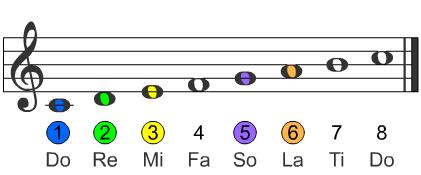
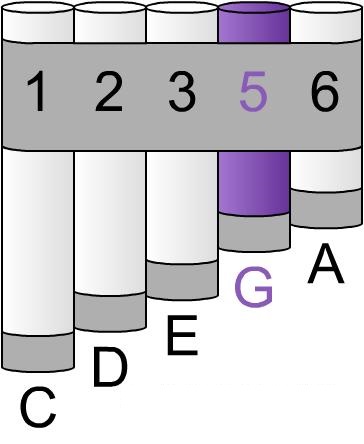
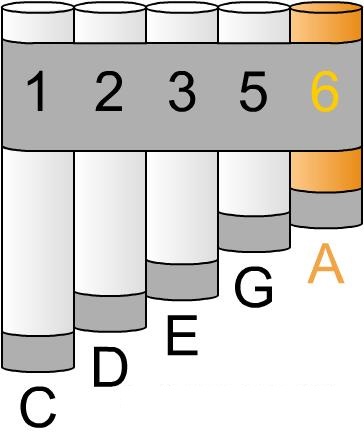
As you will hear, the longer the pipe, the lower the pitch — the shorter the pipe, the higher the pitch.
Start by clicking your mouse on each pipe (below). Then, choose
a song and start playing.
Playing tip: If you hold down your mouse, the notes will last longer. If you would like to make this
instrument, just follow the directions below.
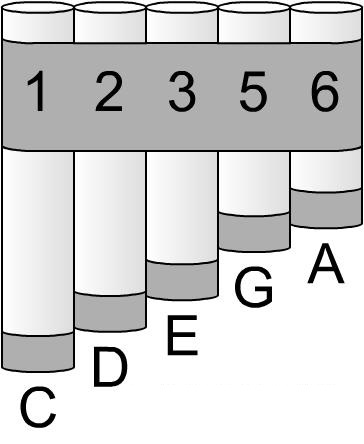

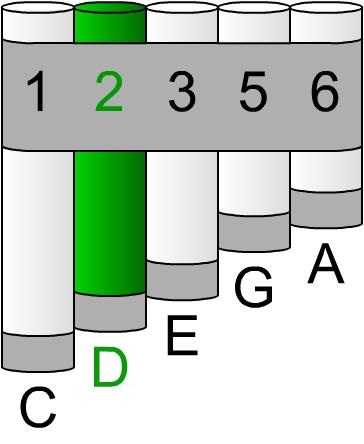
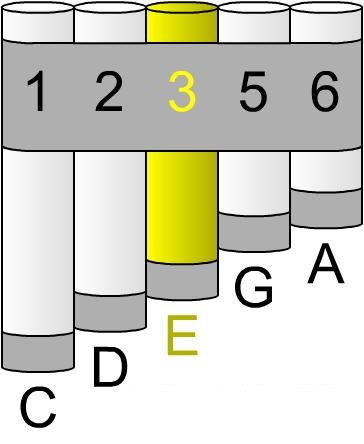

Building a 5-note set of Panpipes
Begin by getting approximately 2 feet of 1/2-inch/schedule-40 PVC sprinkler pipe.
| Inches | Centimeters | ||
| C | 6 1/16 | 15.4 | 1 |
| D | 5 3/8 | 13.6 | 2 |
| E | 4 3/4 | 12.0 | 3 |
| G | 3 15/16 | 9.8 | 5 |
| A | 3 7/16 | 8.7 | 6 |
1) Cut the tubing into the five sections listed on the left. 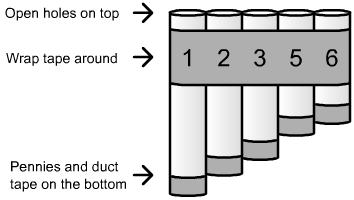
2) Place a penny over one end of each pipe and cover each penny with a 2" X 2" square piece of duct tape.
3) Wrap about 18 inches of duct tape around the set as shown on the right. Blow across the top of each pipe — it's just like blowing on a soda bottle.
If you would like to build an 8-note set that plays many more songs, see below.
Building an 8-note set of Panpipes
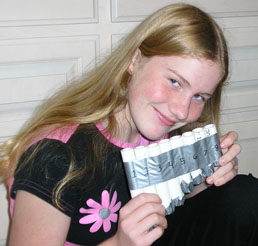 Phil and his daughter,
Sarah, have created a special resource on
building and playing panpipes that includes step-by-step
instructions. Just like our
water bottle xylophone, glockenspiel,
fraction
tubes,
melodic tube drums, and
didgeritubes, our panpipes are tuned to play an 8-note scale in the key of C.
Phil and his daughter,
Sarah, have created a special resource on
building and playing panpipes that includes step-by-step
instructions. Just like our
water bottle xylophone, glockenspiel,
fraction
tubes,
melodic tube drums, and
didgeritubes, our panpipes are tuned to play an 8-note scale in the key of C.
Building instructions are at
Panpipes.pdf.
In case you'd like to build a larger set, the instructions also include an
addendum for Science Olympiad, detailing the measurements for a fully chromatic
27-note set.

For sheet music written in treble clef, and play-along music tracks, check out Phil's Music for Homemade Instruments page.
Copyright © 2004-2023 Phil Tulga

